
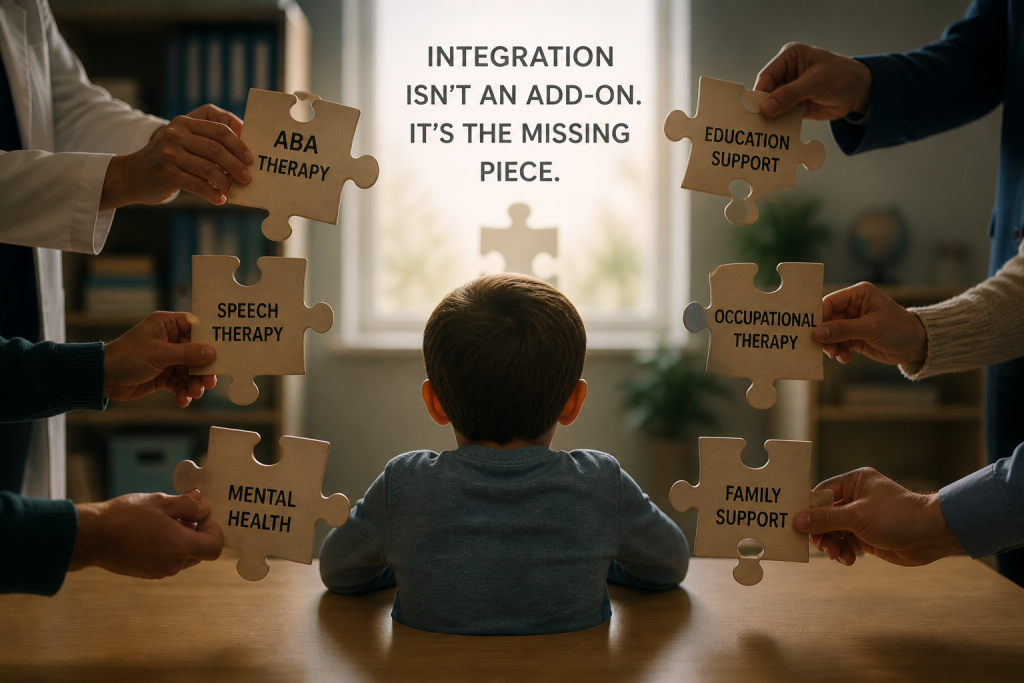
With autism now affecting approximately 1 in 31 children in the United States, the demand for services has grown at a pace the system was never designed to absorb. Over the past decade, access to autism services—particularly Applied Behavior Analysis (ABA)—has expanded rapidly. On the surface, this looks like progress. More providers. More clinics. More children receiving services.
But beneath that growth, something more concerning is happening. Care is becoming increasingly fragmented.
After 25 years working alongside families, clinicians, and interdisciplinary teams, I’ve seen this pattern repeat itself in different forms—but never at this scale. And the truth is uncomfortable: We are expanding access faster than we are building systems that actually works.
Let’s just name one key player in this system: Private equity.
On a positive note, private equity has expanded access. BUT, it has also reshaped the system around what is scalable, not necessarily what is clinically coherent.
And when scale becomes the organizing principle, integration becomes the casualty.
The Illusion of Comprehensive Care
Families are often told they are receiving “comprehensive services.” What that typically includes:
- An ABA provider focused on behavior and skill acquisition
- A therapist addressing emotional regulation or anxiety
- School teams managing academic and behavioral expectations
- Speech and occupational therapists targeting communication and sensory needs
Families are often told they are receiving “comprehensive services.” On paper, that may be true. What that typically includes is an ABA provider focused on behavior reduction and skill acquisition, a therapist addressing emotional regulation, anxiety, or family dynamics, school teams managing academic performance and behavioral expectations, and speech and occupational therapists targeting communication, regulation, and sensory integration. Each provider may be competent. Each may be well-trained. Each may be working with genuine care and intention. And yet, the system surrounding them was never designed to connect their work.
What families actually experience is something very different from what was promised. They move from one appointment to the next, carrying pieces of information between providers—repeating the same history multiple times, trying to reconcile conflicting recommendations, and wondering why progress in one setting doesn’t translate to another. A behavior that is reduced in therapy reappears at school. An emotional breakthrough in session doesn’t show up at home. A skill mastered in one environment fails to generalize anywhere else. Not because the child isn’t capable, but because the interventions are not aligned.
Behind the scenes, providers are also working in isolation. Data is collected but rarely shared in a way that informs other disciplines. Clinical insight is developed, but not translated into actionable strategies across settings. Treatment plans exist, but they are written within disciplines—not across them. No one is responsible for holding the whole picture. So, the burden quietly shifts to the one group least equipped to carry it: parents.
Over time, something subtle but significant happens. Families stop asking, “What does my child need next?” and start asking, “Which provider should I listen to?” That shift is the cost of fragmentation. Because what looks like “comprehensive care” from the outside is often, in practice, a collection of well-intentioned efforts that never quite come together.
Why This Is Happening Now
This fragmentation is not accidental—it is structural, and in many ways, it is the predictable outcome of how the field has chosen to grow. Today, a child diagnosed with autism may be involved in three to six different services at any given time—ABA, speech therapy, occupational therapy, psychotherapy, school-based interventions, and sometimes additional medical or specialty supports. Each of these services operates within its own framework, its own language, and its own treatment goals.
While access has expanded significantly—driven by rising prevalence rates (now approximately 1 in 31 children), workforce shortages across BCBAs and RBTs, high turnover, increasing supervision demands, and private equity-backed models prioritizing scale and efficiency—the system has not evolved in parallel to coordinate this complexity.
Over 25 years ago, this exact gap is what led me to pursue my doctoral degree in psychology, to study joint attention in children with autism, and ultimately to build a collaborative, integrative treatment model at Cadenza Center. Because the truth is, autism is not a behavioral problem, a speech delay, or a sensory issue in isolation—it is a developmental, relational, and human experience that requires continuity, interpretation, and guidance across domains. Yet we continue to deliver care as if these pieces can function independently.
“We’ve built a system where multiple experts surround a child—but no one is truly responsible for understanding the whole child. That’s not comprehensive care. That’s fragmented expertise.”
The result is a system where families are expected to synthesize complex, and at times conflicting, recommendations on their own—without a single, qualified professional guiding them through the medical, behavioral, developmental, psychological, social, and human journey that autism represents. These forces have expanded access, but they have also exposed a fundamental flaw: we are scaling services faster than we are building systems capable of integrating them. And without that integration, more care does not mean better care—it simply means more moving parts.
The Real Cost of Fragmentation
When care is not integrated, what looks like “treatment” from the outside often feels like confusion from the inside. Families move from one service to another without a clear trajectory, trying to make sense of progress that doesn’t quite hold together. Providers operate in parallel rather than in true collaboration, each doing meaningful work within their scope—but without a shared framework to guide it. As a result, progress becomes inconsistent across settings. Gains made in one environment don’t translate to another. Clinical recommendations don’t build on each other—they compete, overlap, or unintentionally contradict. And no one steps back to ask whether the system itself is working as intended.
Over time, families don’t just feel overwhelmed—they begin to lose trust in the process itself. Not because they doubt the clinicians, but because they can’t see a coherent path forward. They’re left asking questions no one seems fully positioned to answer: Is this working? Are we doing too much? Not enough? What actually matters most right now?
And clinicians—many of whom entered this field with deep purpose—feel it too. Burnout in this space is often attributed to workload, but that’s only part of the story. What’s harder to name is the quiet erosion that comes from working within systems that don’t allow for integration, where insight can’t be fully applied, and where the work never quite feels complete. When clinicians are asked to operate in fragments, even their best efforts can start to feel disconnected from meaningful outcomes.
What’s Missing
The field has become increasingly specialized, with disciplines evolving in depth and expertise, but not in coordination with one another. Behavioral data is collected with precision, yet too often it is interpreted in isolation, without being meaningfully integrated into a broader developmental or psychological understanding of the child. Emotional insight is uncovered in therapy—moments of clarity, awareness, even breakthrough—but those insights rarely make their way into behavior plans or educational strategies in a way that changes how the child is supported day to day. Each piece of the work exists. Each has value. But they are not designed to inform one another.
So the responsibility shifts—quietly, but significantly—to the parents. They are left to coordinate between providers, to interpret clinical language across disciplines, to reconcile recommendations that don’t quite align, and to make decisions without a unifying framework to guide them. They are expected to become the integrators of a system that was never built to integrate itself. And over time, that burden becomes unsustainable.
This is the integration gap—not a lack of care, not a lack of expertise, but a lack of connection between the very elements that are meant to support the same child.
A Different Way Forward
Cadenza Center was built in direct response to the gap this field continues to navigate. Not as a reaction to trends, but as a deliberate, clinically grounded model shaped over 25 years of working with children, families, and multidisciplinary teams. Our approach does not treat autism as a collection of isolated needs—it recognizes it as a complex developmental experience that requires thoughtful integration across behavioral, psychological, emotional, and relational domains. Instead of asking families to coordinate care across disconnected providers, we assume responsibility for holding the full picture. Clinical insight is not contained within silos; it is translated, aligned, and applied across settings in a way that creates continuity, clarity, and meaningful progress. This is not only intuitively appropriate for families—it is clinically necessary for outcomes to generalize, sustain, and truly reflect growth.
What makes this model different is not simply that it is collaborative, but that it is intentionally designed to be so. Every component of care is informed by a shared framework, guided by professionals who understand both their discipline and how it connects to others. Families are no longer left asking which recommendation to follow—they are guided through a coherent, evolving understanding of their child. In a field navigating increasing demand, workforce strain, and pressure to scale, Cadenza represents a different standard: one that prioritizes integration as the foundation of effective care. We are not trying to keep up with the pace of the industry—we are working to redefine what quality, clarity, and clinical excellence look like within it.
“We are not here to add more services to an already complex system—we are here to change how those services come together. With the clinical depth, the determination, and the outcomes to support it, we are building a model that doesn’t just respond to the challenges in this field—but reshapes what autism care can and should be.”
We can do better—but more importantly, we can’t keep pretending this is good enough. Families deserve more than a system that asks them to piece together care while professionals operate in silos. They deserve a model that was actually designed to support the full complexity of their child. The reality is, we are not lacking knowledge or expertise—we are lacking the will to organize it in a way that makes sense. And every day we delay that shift, families absorb the cost. We cannot keep scaling services while ignoring the structure that holds them together.
At some point, continuing as we are is no longer just inefficient—it’s irresponsible. The field doesn’t need more time. It needs a decision to do better.



